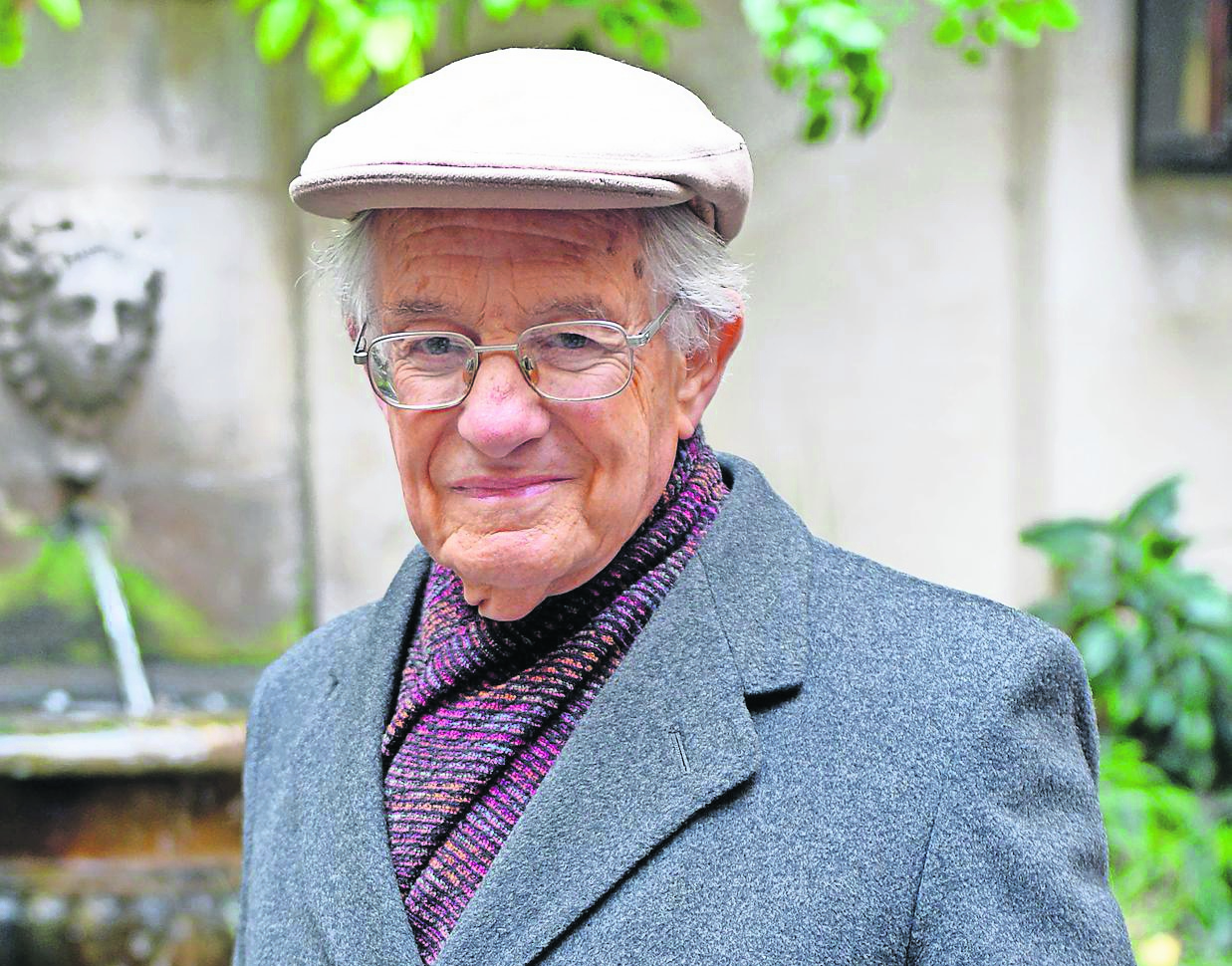
Curious four-year-olds would always be interested in a new neighbour, and the man who moved into a block of flats opposite Edgar Feuchtwanger’s family in 1929 certainly knew how to make an impression.
“A big black car draws up on the other side of the street,’’ he recalled. “A chauffeur in military uniform opens the passenger door. A man steps out, looks at Aunt Bobbie, then me. He has a little black moustache, just like Papa’s.”
The new neighbour moving into the Prinzregentenplatz in Munich was none other than Adolf Hitler. The Nazi leader had attained notoriety in 1920s Germany with his publicity stunts, beer-hall rhetoric and time in prison following an attempted putsch, where he had begun writing his rambling, viciously antisemitic and disturbingly ambitious political testament, Mein Kampf. Munich was where his movement seemed strongest, though in the next few years, the Nazi party would extend its national presence greatly. In 1933, machinations at the top of the enfeebled Weimar Republic allowed Hitler to inveigle his way into power as chancellor, after which he would ruthlessly turn the country into a dictatorship. The new chancellor, however, often ill at ease in the German capital, Berlin, returned frequently to his Munich home.
There was a banality to Hitler’s presence, Feuchtwanger later recalled. Feuchtwanger was by then an accomplished historian and refused to embroider his memories for sensationalist effect. He remembered his mother complaining that their milk deliveries were being jeopardised by the demands of Hitler’s growing entourage. When Feuchtwanger, out for a walk with his nanny, first came face to face with Hitler himself, he was dressed merely in a mackintosh and trilby. Sometimes, from another vantage point in a friend’s flat, he spotted the Nazi firebrand dozing in a garden deckchair.
After Hitler became chancellor in 1933, however, there were more striking and sinister sights and sounds to observe: the screeching of his motorcade’s tyres, the jackboots of his bodyguards, the crowds outside his flat shouting “Heil Hitler’’. One morning in June 1934, Feuchtwanger noticed a commotion and realised later that this was probably the moment when Hitler set off to arrest senior figures in his SA storm troopers, who were then murdered in the Night of the Long Knives. The doomed SA leader Ernst Röhm was another near neighbour Feuchtwanger had come across, “a thickset, brutish-looking man”.
In 1938, he saw the chancellor return in triumph to Munich after annexing Austria in the Anschluss. Later that year, when European leaders gathered to sacrifice the security of Czechoslovakia in the Munich agreement, the British prime minister Neville Chamberlain arrived obsequiously at the Führer’s flat to sign the infamous piece of paper promising, Chamberlain vainly claimed, “peace in our time”.
Despite their grandstand view of the Führer’s activities, Feuchtwanger’s Jewish family took some time to realise the peril that Hitler’s murderous, antisemitic ambitions posed to them. They were a family that had seen themselves as highly successfully integrated into German society. His mother, Erna, was a dressmaker, and his father, Ludwig, had trained as a lawyer and ran a successful publishing house. Eminent literary figures, including Thomas Mann and Bertolt Brecht, visited their home. “My father was very connected to German culture,” he said. “That was his life.”
While his father’s parents had been Orthodox Jews, he explained, “Jewishness didn’t play a big role in my life before the rise of National Socialism”. His parents’ initial response to the imposition of Nazi ideology in the Third Reich was to attempt to weather what they hoped would be a short-lived storm, talking of Hitler as a “ridiculous figure” who would be a “temporary phenomenon”.
His father was sent to Dachau and the Gestapo looted their home
When Edgar brought back schoolwork he had embellished with swastikas to please a Nazi-obsessed teacher, his father did not complain, knowing that such a response “would have endangered us all. They didn’t want trouble; they didn’t want me to fight back.” Edgar had to attend long school rallies with arms outstretched in the “Hitler greeting’’, endured by resting his arm on the shoulders of the pupil in front.
Gradually, he noticed the spread of antisemitism into social as well as school life, as he was no longer invited to other pupils’ homes.
Pressure on his family intensified after Nazi race laws took effect, imposing all kinds of restrictions on Jews, and his father lost his job. The family’s position had been further endangered by the anti-Nazi activities of his uncle, Lion Feuchtwanger. He was a successful playwright and novelist whose bestselling work Jud Süss (Jew Süss) was later twisted by the Nazis into an antisemitic propaganda film.
Another of his novels, Erfolg (Success), had enraged Hitler by satirising him as a garage mechanic leading a party called the “True Germans’’, stirring up aggrieved inhabitants of the beer cellars facing hyperinflation and economic ruin with wild rhetoric.
The writer had been forced into exile in 1933, but Feuchtwanger’s own family did not seriously consider leaving until his father was arrested and sent to Dachau concentration camp after the Kristallnacht pogrom of 1938. While he was there, the Gestapo arrived at their flat to loot his library, talking with supreme cynicism of “making the books secure”.
“We just felt so helpless,” Feuchtwanger remembered, fearing “that someone could come and knock us down dead and no one would do anything”. After six weeks, his father was (unusually) released but was now “seriously weakened”, very thin, his shaved head covered with signs of bruising and frostbite. “I scarcely recognised him,” Feuchtwanger wrote later. The family immediately began to plan emigration, helped by Lion, buying a family visa for Britain for the huge sum of £1,000. Edgar was the first to move in February 1939, aged 14, travelling by train to the Dutch border and then on a boat to England.
His parents arrived several months later. “I felt I had left an evil empire, that’s the phrase that stuck in my mind.”
His father, initially detained in wartime England because of his nationality, later worked as a translator for the British Army but died in 1947. Edgar, meanwhile, won a scholarship to Winchester College in the town where the family settled, his classmates faced with his surname deciding to nickname him “fish finger”.
After military service, he studied history at Cambridge, taught in adult education and joined the academic staff of the University of Southampton. In 1962, he married Primrose Essame, a teacher and the daughter of a major general. They had three children: Judith, who became an HR director, Adrian, a translator and interpreter, and Antonia, a member of the South Downs National Park Authority.
Feuchtwanger’s academic publications ranged across British and German history.
There were biographies of Gladstone and Disraeli and an account of Democracy and Empire, Britain 1865-1914. He also wrote on the German roots of the British monarchy in publications such as Albert and Victoria. On German history, he published a survey of the fateful 1918-33 period, From Weimar to Hitler, an account of Prussia: Myth and Reality, and a biography of Otto von Bismarck, exploring how the Junker landowner became a formidable state-builder, diplomat and ruthless pursuer of power, “one of history’s most prominent back-seat drivers”. He was also a shrewd observer of dramatic developments in modern German life, such as the reunification that followed the end of the Cold War.
Feuchtwanger was a visiting lecturer in Frankfurt and became a regular visitor to the country of his birth. For his contribution to Anglo-German understanding, he was awarded the German Federal Order of Merit as well as an OBE in Britain.
He once joked ruefully that, despite all his accomplishments, he was known by some colleagues simply as “the bloke who lived opposite Hitler”. In later life, realising the significance of what he had witnessed as one of the last surviving individuals to have seen Hitler at close quarters, he devoted time to recording his memories. He published an autobiography in 2010, translated into many languages, and a novelised version of his experiences as a child in 2012. His touching and often humorous letters home to his parents after arriving in England, compiled with the help of his daughter, Antonia, were published in German this year and will appear in English in 2026.
Hitler, he reflected, had been dangerously underestimated. His story showed that “when societies are plunged into crisis and citizens become paranoid, it is time for vigilance. The veneer of civilisation turns out to be thin. Scapegoats are sought.” The Nazi leader might have had his banal or comic side, but he was “an extremely clever man” who “understood modern societies”.
His rise had ended in the horror of the Holocaust, whose millions of victims had included a favourite aunt, Bella, murdered in Auschwitz. Feuchtwanger had marked his own survival after the war by returning in the 1950s to visit the Munich flat where, as a young Jewish boy, he had observed the Nazi leader living. It was now a police station. “And I thought, I’m still here, and Hitler would be spinning in his grave if he knew.”
Edgar Feuchtwanger OBE, historian, was born on September 28, 1924. He died on August 22, 2025, aged 100

No comments:
Post a Comment