Cavemen’s top-notch way to ‘keep records’ before the invention of writing
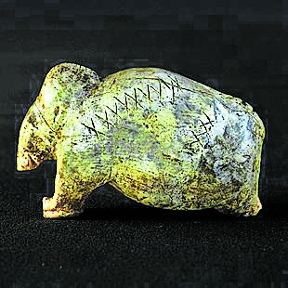
More than 40,000 years ago, Europeans were carving lines, dots, crosses and neatly spaced notches into small ivory sculptures.
A study has challenged the assumption that these marks were purely decorative and suggests they were a system for storing information, devised more than 35,000 years before the first writing appeared. Christian Bentz, a linguist at Saarland University, and Ewa Dutkiewicz, an archaeologist at the Museum for Pre- and Early History in Berlin, analysed more than 3,000 marks carved into 260 objects from the Ice Age.
Many came from caves in the Swabian Jura mountain range of southwestern Germany, a region renowned for its Ice Age art. An ivory mammoth figurine was marked with crosses and dots, while an “adorant”, depicting a lionhuman hybrid, was covered with orderly notches. Analysing the objects with computational techniques, they found the carvings resembled proto-cuneiform, a system of signs in southern Mesopotamia from about 3,000BC.
Proto-cuneiform was not “writing” in the modern sense but a set of impressed symbols used for bureaucratic records. Like the Ice Age artefacts, it contained repetitive and highly structured sequences.
The analysis does not mean that Ice Age Europeans were writing language.
Modern alphabets encode speech and carry far more information in the same amount of space. The markings do not appear to represent words or grammar and the study does not settle what, precisely, might have been recorded — ownership, hunting tallies, ritual knowledge or something else entirely — but if its findings are correct, the ability to visually encode information came tens of thousands of years before writing.
Dutkiewicz suggested more study was needed. “There are many sign sequences to be found,” she said, before adding: “We’ve only just scratched the surface.”

No comments:
Post a Comment