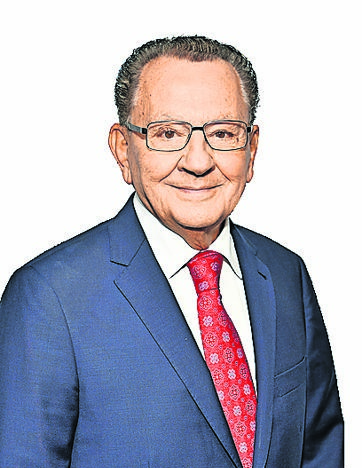
For nearly 40 years, Frank Caprio presided over a municipal court in Providence, Rhode Island, mostly hearing cases involving speeding and parking tickets and other minor offences. Nobody would claim he administered justice impartially. On the contrary, the personal circumstances of defendants were usually uppermost in his mind.
A woman who faced $500 in parking fines broke down in tears as she explained how her son had been killed the previous year and she had recently been ejected from her apartment. “I’m just having a really tough time, your honour,” she wept. Caprio reduced the fines to $50. Told that the fine would leave her with only $5, he dismissed the case outright. A Vietnam veteran admitted a parking offence, but explained that he had been attending a veterans’ hospital with inadequate parking facilities. “You go for medical treatment provided by the government and they give you a $100 parking ticket?” Caprio exclaimed. “Thank you for your service and the matter is dismissed.”
A high-school student was let off a fine for driving through an amber traffic light provided he promised to go on to college. A 96-year-old man was fined for speeding outside a school while taking his disabled son to a doctor’s appointment: case dismissed. A woman was excused a speeding fine after Caprio learnt that she was pregnant. He called his ruling a “baby gift”.
Word of Caprio’s kindness and compassion began to spread after his younger brother, Joey, began filming his court appearances.
In 2000 they were picked up by the local ABC affiliate station, which broadcast them on Saturday nights under the title “Caught in Providence”. From 2018 they were syndicated nationally, and shown in nearly 200 cities across the US. Caprio swiftly became an internet sensation, with hundreds of millions of people around the world watching clips of his unique brand of justice on social media.
Caprio ran his court with humour, compassion — and a dash of showbusiness: he would sometimes call on defendants’ children to join him on the bench and pass judgment on their parents. His rulings infuriated Providence’s law enforcement agencies, but delighted his supporters. They dubbed him “the nicest judge in the world”.
Frank Caprio was born in Providence in 1936, the second of three sons of Italian immigrants. He was raised in a humble home without hot water in the city’s Federal Hill district, its “little Italy”. He attributed his compassion to his father, Antonio, a milkman who had arrived in America when he was 12 and would himself pay the bills of customers who fell behind with their payments. “His mantra was ‘help people when you can’,” Caprio recalled.
He was educated at Providence’s Central High School, represented its wrestling team, and worked as a shoeshiner and dishwasher in his spare time. After graduating from Providence College and becoming the first of his family to earn a degree, he took a job as a history teacher at another Providence high school while studying law at a night school in Boston. He also served as a combat engineer in the US Army Reserve for six years from the age of 17.
He married in 1965. He and his wife, Joyce, went on to have four sons and a daughter. While he was still teaching, he set up his own law firm in Providence, which two of his sons would later join. It stayed open until 11pm.
Caprio also served for six years on Providence city council in the 1960s, and ran unsuccessfully for Rhode Island attorney-general in 1970, but it was after the Providence council appointed him a part-time municipal court judge in 1985 that his career really began to take off. His brother, Joey, an amateur film-maker, was responsible for filling two hours a day on a new, non-commercial public access television channel in Rhode Island, and was short of material. Joyce Caprio suggested he film her husband’s court cases. “At first I said no because I didn’t think anybody was going to be interested in watching and I was going to be the laughing stock of Rhode Island,” Caprio said. But he relented, gave defendants the choice of having their hearings televised (most agreed), and his unique brand of empathetic justice went on to catch the popular imagination.
Caprio finally retired in 2023 and had a courtroom named after him. His court had been a place “where people and cases are met with kindness and compassion”, he said.
“I think if there are certain circumstances in an individual’s life or it’s a close call, I give them the benefit of the doubt. I don’t subscribe to the theory that because you were charged then you must be guilty.”
Frank Caprio, judge, was born on November 24, 1936. He died on August 20, 2025, aged 88.

No comments:
Post a Comment